
The outside ambient sensor
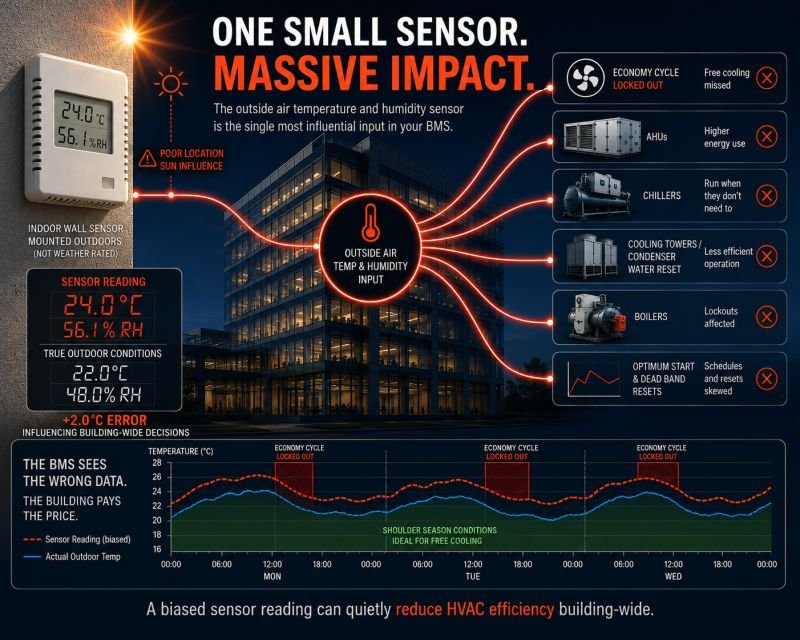
The outside ambient sensor is the single most influential input in a BMS, and it's the one we verify the least carefully.
Think about it. Most of the energy efficient control measures that govern your HVAC plant rely on it. Economy cycle (free cooling), optimum start, dead band resets, condenser water reset, chiller and boiler lockouts. One reading, influencing a large proportion of your mechanical assets. For context, a faulty zone temperature sensor can affect one mechanical asset. A faulty outside air sensor can have building wide repercussions.
The right device for the job is built for outdoor air measurement. What actually gets installed is often a room or duct mounted sensor, installed somewhere convenient rather than somewhere correct.
An extremely low cost decision that's less than $100 to 200, made in 30 to 60 minutes at install, undermining the operation of plant worth tens of thousands and even hundreds of thousands of dollars. Sounds odd when you say it out loud, right? But it happens more than you'd expect.
A real world example. While auditing a building recently, I happened to notice the outside air temperature was reading about 2 degrees higher than another site I was working on 100 to 200 metres away. Investigation showed the consistent discrepancy was due to poor installation and device selection. It was a sensor that was influenced by the sun. And this arrangement has been operating for over two decades.
Two degrees doesn't sound like much. It's enough to lock out economy cycle for tens to hundreds of hours a year on a building that should have been free cooling through most of the shoulder seasons. The chillers run when they don't need to. Tenants pay for it on the OpEx side through the energy bill. Owners pay for it on the CapEx side through shortened asset life and higher maintenance.
Here's the kicker. We're focused on layering new optimisation strategies and new technologies on top of our buildings. But we rarely go back and question the fundamentals those strategies are built on. The sensors. The install quality. The accuracy of the inputs everything else relies on. Get that right and the return on investment likely pays itself back in a matter of weeks (or months).
When was the last time you verified your outside air sensor was reading accurately? And how is it impacting your building?