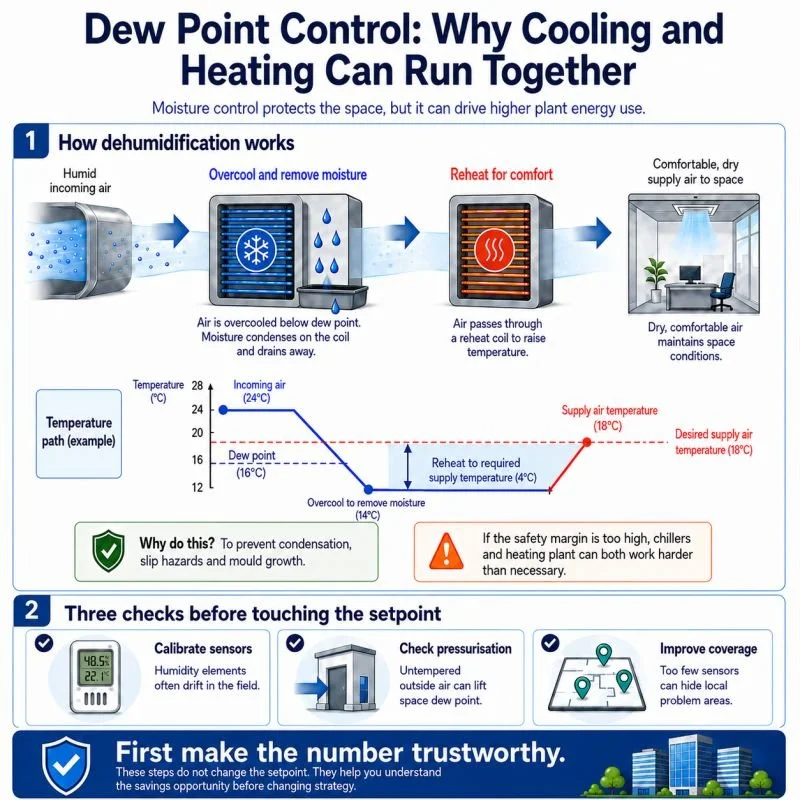
Dew point control strategy optimisation
So in my last post I talked about how dehumidification in commercial buildings works. We strip moisture out of the air before it enters the space to prevent condensation. Condensation on surfaces creates potential slip hazards and mould growth.
If you have a dew point control strategy in your building you might notice your heating plant is running through summer at the same time as the chillers, it's likely caused by the dew point strategy. In certain climates it can account for a significant portion of your energy consumption and asset degredation.
Typically the safety factor can become quite considerable, and that's done intentionally to limit public liability. No one wants to stand in a tenant space in front of the owner being reprimanded. So risk aversion comes naturally to us and that's the problem.
Left unchecked that safety factor dictates how hard your chilled water and heating hot water plants run all year, and no tenant or technician without a hand held calibrated sensor can accurately gauge dew point in a space. So the saying if it ain't broken don't fix it is apt. It's left as is, while your assets potentially work way harder and longer than required.
So what steps can you take?
1️⃣ Calibrate the dew point sensors in the field. It's very common during audits to find the humidity element has drifted considerably.
2️⃣ Confirm the space is positively pressurised. If untempered air comes into the space it can lift the dew point in the area significantly, causing your assets to strip air even harder. Normally happens after tenant modification.
3️⃣ Ensure good coverage. The design have very limited sensors on the floors or poorly positioned sensors during fitout.
None of these change the setpoint. They just make the number underneath it trustworthy, and that's the conversation you have first.
Not advocating people start playing with their dew point control strategy blindly, but if you're serious about reducing your building's energy consumption these are targeted steps that can give you a better idea of how much energy savings are on the table.